



The Application of Artificial Scarcity in Video Game Design
 Milijana Komad / 10min
Keywords: Artificial Scarcity, Video Gaming, Game Design, Player Behaviour, Psychological Manipulation
Abstract:
This paper explores the concept of artificial scarcity and its strategic utilization in video game design. As a psychological manipulation technique, artificial scarcity significantly influences player behaviours and decisions, shaping engagement patterns. Detailed case studies provide a comprehensive understanding of this principle’s deployment and its implications, illustrating the concept from a product design perspective.
Introduction
Video game design often leverages psychological techniques to promote player engagement and monetization. Artificial scarcity, a concept widely recognized in marketing and economics, has also found its way into the gaming industry, shaping player behaviours and enhancing game dynamics. This paper aims to investigate the intricate applications and implications of artificial scarcity in the world of gaming.
Artificial Scarcity in Gaming: Conceptualization and Design
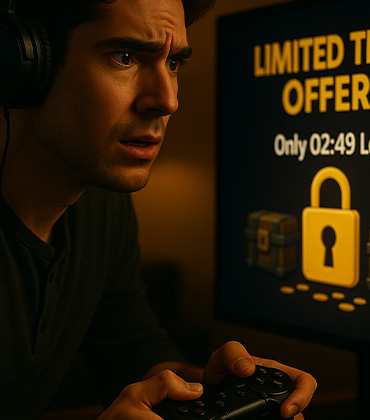
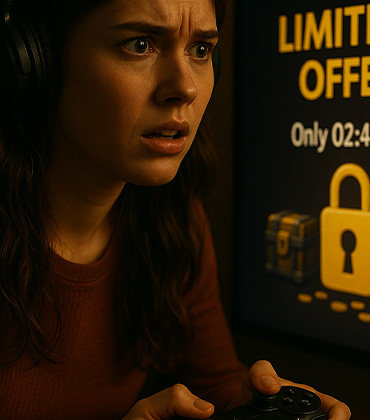
Artificial scarcity refers to the deliberate restriction of the availability of certain items or experiences. In gaming, this can take form through limited-time events, exclusive in-game items, or special characters, all available for a certain period or in limited quantities. By creating an illusion of scarcity, game designers can invoke a sense of urgency, encouraging players to engage more with the game or make in-game purchases.
“Design is about solving problems, not decorating.”
Jeffrey Zeldman
Case Study: Fortnite
Epic Games’ Fortnite effectively employs artificial scarcity with its “Battle Pass” system. Each season introduces exclusive rewards, skins, and emotes, available only for a limited duration. Once the season ends, these items become unavailable, making them coveted assets and driving player engagement and in-game purchases.
Case Study: Pokémon GO
Niantic’s Pokémon GO capitalizes on artificial scarcity through its limited-time events where certain Pokémon species become temporarily available. The game also features “shiny” Pokémon — rare, alternate-color versions of regular Pokémon. These scarce entities inspire players to participate more actively in events and hunt more diligently, driving continuous engagement.
Implications for Game Design
While artificial scarcity can be a powerful tool to drive engagement and monetization, it’s crucial for game designers to be mindful of its potential impacts. Overuse of this technique could lead to player fatigue or even resentment. As such, game designers must carefully balance the use of artificial scarcity with the overall player experience and game economy.
Conclusion
The use of artificial scarcity in video game design offers a potent mechanism for influencing player behaviour and enhancing game dynamics. However, the careful and ethical deployment of this principle is crucial to prevent negative player experiences and maintain game balance. As the gaming industry continues to evolve, it will be interesting to observe how artificial scarcity and similar psychological principles are effectively and ethically integrated into the design of enjoyable, engaging gaming experiences.

References:
1. Crawford, G., & Gosling, V. K. (2009). More than a game: The computer game as fictional form. Manchester University Press.
2. Deterding, S., Dixon, D., Khaled, R., & Nacke, L. (2011, May). From game design elements to gamefulness: defining “gamification”. In Proceedings of the 15th international academic MindTrek conference: Envisioning future media environments (pp. 9–15). ACM.
3. Hamari, J., & Lehdonvirta, V. (2010). Game design as marketing: How game mechanics create demand for virtual goods. International Journal of Business Science & Applied Management, 5(1), 14–29.
4. Lewis-Evans, B. (2018). A brief overview of the psychological literature on in-game purchases. International Journal of Serious Games, 5(3), 37–48.
5. McGonigal, J. (2011). Reality is broken: Why games make us better and how they can change the world. Penguin.
6. Nacke, L. E., & Deterding, S. (2017). The maturing of gamification research. Computers in Human Behavior, 71, 450–454.
7. Peitz, M., & Waelbroeck, P. (2006). Why the music industry may gain from free downloading: the role of sampling. International Journal of Industrial Organization, 24(5), 907–913.
8. Sicart, M. (2008). Defining game mechanics. Game Studies, 8(2), 1–14.
9. Wu, M. (2011). The core drivers of gamification. Customer Engagement, 6, 15–17.
10. Zagal, J. P., Björk, S., & Lewis, C. (2013). Dark patterns in the design of games. In Foundations of Digital Games.





Related posts
Psychology / Design
Psychology / Design
The Exploitation of the Pay-to-Win Model in Video Game Design
Psychology / Design
The Art of Teasing Future Content in Video Game Design
DIGITAL DESIGN EXPERIENCE
MILIJANA KOMAD